

Latent‑Y
The First Lab‑Validated Agent for Drug Design
Autonomous Drug Design from Text Prompts
Today, Latent Labs launches Latent-Y, an AI agent that autonomously designs antibodies from a text prompt, compressing weeks of expert work into hours. Powered by Latent-X2, Latent Labs' frontier model for drug-like antibody design, Latent-Y brings structural drug design to any researcher. Starting from text prompts that specify design goals and constraints, Latent-Y designs novel antibodies without requiring intervention, with lab-confirmed binders reaching single-digit nanomolar affinities.
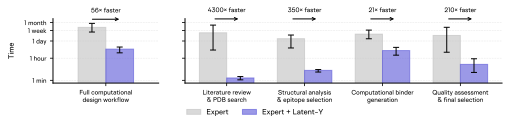
Latent-Y is a force multiplier for drug discovery teams. Operating in the same environment as protein design experts, with access to bioinformatics tools, biological databases, and external publications, it applies expert-level reasoning to navigate from research objective to lab-ready candidates. A single researcher can now run a large number of design campaigns in parallel, transforming the scale at which a drug discovery team can explore therapeutic opportunities. Experts working with Latent-Y completed design campaigns 56-fold faster than independent expert time estimates. Full results available in our technical report.
Latent Labs is opening access to selected partners. Apply at platform.latentlabs.com.
From Prompt to Lab‑Ready Candidates
The video below shows a complete Latent‑Y design campaign—from text prompt to computationally passing binder candidates.
Lab‑Validated Results
Across nine targets, Latent‑Y produced lab-confirmed binders against six, with affinities reaching the single-digit nanomolar range.
Every confirmed binder is a novel molecule, designed de novo from a text prompt.
Lab Validation for Three Campaign Types
We validated Latent‑Y across three qualitatively distinct campaign types, spanning nine targets. The agent produced lab-confirmed nanobody binders against six, achieving a 67% target-level success rate with binding affinities reaching the single-digit nanomolar range—without human filtering or intervention at any stage.
-
Epitope discovery
Given a therapeutic specification—a desired mechanism of action, a functional outcome, or constraints on the binding site—Latent‑Y applies biological reasoning to identify epitopes matched to those goals, then proceeds to design.
-
Cross-species binder design
Latent‑Y generates antibodies that bind homologous targets across species, supporting the translational studies required to progress a program toward the clinic. As an early indication of what is possible, Latent‑Y designed nanobodies that simultaneously bound human and cynomolgus homologs, confirmed in the laboratory.
-
Design from publication
Given a scientific paper as input, Latent‑Y identifies the relevant targets and epitopes, reasons about the published mechanism of action, and autonomously designs binders accordingly. In one demonstrated campaign, the agent processed a publication on blood-brain barrier crossing and designed antibodies targeting human transferrin receptor (hTFR1)—confirmed in the laboratory, without any manual curation of the input.
Drug Design at Scale
Latent‑Y compresses what would take expert teams weeks into hours of autonomous work. Unlike an expert team, it can run many campaigns simultaneously. This parallelism transforms what drug discovery organisations can pursue: more targets, more design strategies, more exploration, with the same resources.
In user studies, experts working with Latent‑Y completed design campaigns 56-fold faster than working alone. When running campaigns in parallel across multiple programs simultaneously, these gains compound further.
Scientists remain in control throughout. Latent‑Y can run fully autonomously end‑to‑end, or pause at each stage to surface progress summaries and recommended next steps for review. Every design decision is recorded reasoning that scientists can evaluate, challenge, and build on.
Latent‑Y's Distinctive Features
-
Flexible autonomy, full transparency
From fully autonomous end‑to‑end campaigns to interactive human-in-the-loop collaboration—with every design decision logged and interpretable at every step.
-
Lab validated end‑to‑end
Lab-confirmed binders across six of nine targets attempted, with affinities reaching the low nanomolar range.
-
Force multiplier for experts
User studies demonstrate a 56-fold expert acceleration—Latent-Y compresses weeks of expert computational work into hours.
-
Parallel campaign execution
A single researcher can run multiple campaigns simultaneously, across targets and modalities.
-
Design from high-level research objectives
Process natural language goals, research work plans, or scientific publications directly as campaign inputs.
-
Powered by Latent-X2
Drug-like antibodies with drug-like developability, enabling difficult targets and complex design goals from the first generation.
-
Integrated into Latent Labs Platform
Latent‑Y is available on the Latent Labs Platform, offering the complete lab-validated no-coding workflow.
-
Broad modality coverage
The same agent architecture supports VHH, macrocyclic peptide, and mini-binder design campaigns.
Discussion
"Latent-X2 gave us the breakthrough: antibodies designed computationally with drug-like developability. Latent‑Y builds on that foundation with an expert reasoning layer that handles the full workflow autonomously. The result is speed and scale that weren't possible before—a single researcher running dozens of campaigns in parallel. This is what it looks like when AI becomes a true force multiplier for discovery teams." — Simon Kohl, CEO and founder of Latent Labs
This work presents a significant milestone in computational drug discovery: the first autonomous agent for de novo biologics design with lab-validated results. Using text prompts expressing goals and constraints, Latent‑Y delivers novel antibody sequences confirmed in the laboratory, demonstrating that the full workflow of an expert drug design campaign can be executed autonomously.
We regard this as a meaningful step towards the broader goal of an AI scientist for biology.
All results are preclinical, with animal studies and clinical trials remaining ahead. Latent‑Y accelerates the computational stages of drug discovery—it does not replace the experimental stages that must follow. Current limitations reflect the performance of the underlying frontier LLM, the generative capabilities of Latent-X2, and the tools available to the agent.
Closing the loop with experimental feedback, expanding the agent's action space, and ultimately integrating with robotic laboratories are promising directions for future work.
Access
Latent‑Y is available to selected partners through the Latent Labs Platform. Interest for access can be expressed at partnerships@latentlabs.com.